
Although great care has been taken in the compilation and preparation of all directory entries to ensure accuracy, we cannot accept responsibility for any errors or omissions. Any medical information is provided for education/information purposes only and is not designed to replace medical advice by a qualified medical professional. Please see our disclaimer at the bottom of this entry.
What is a Central Line-associated Bloodstream Infection (CLABSI)?
A central line-associated bloodstream infection (CLABSI) is a serious infection that occurs when microorganisms enter the bloodstream through a central line (also known as a central venous catheter). CLABSIs are healthcare-associated infections. CLABSIs may be difficult to treat because of the growing resistance of germs to the available antimicrobials. Therefore, CLABSIs are associated with increased mortality, healthcare costs, and length of hospital stay.
What is a central line?
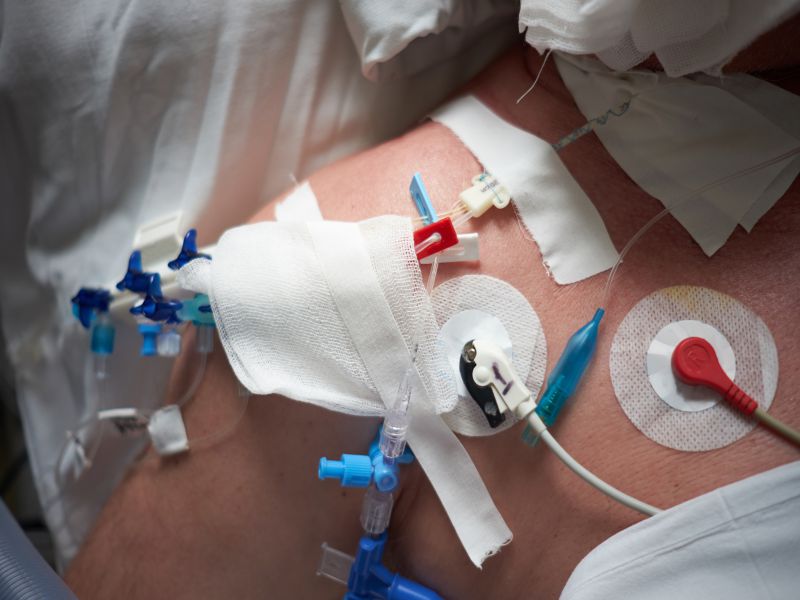
A central line is a tube (catheter) that physicians often place in a major vein in the neck, chest, or groin to give medication, to provide fluids, or to help conduct medical tests. A central line accesses a large vein that is close to the heart, so it is different from standard intravenous lines which are used to give medicine into a vein near the skin’s surface.
Moreover, a central line may remain in place for weeks or months and may be used to give therapies several times a day. Indeed, central venous catheters are important to treat a lot of diseases in hospitals (especially in intensive care units), in long-term care facilities, in dialysis centres, and even at home after a hospital stay or due to a long-term treatment for cancer.
How do patients get a CLABSI?
Germs, such as bacteria or fungi, may cause a CLABSI by travelling down a central venous catheter, and entering the bloodstream.
What are the symptoms of a CLABSI?
Some of the common symptoms and signs of a CLABSI are fever and chills, red skin and soreness around the central line.
How is a CLABSI diagnosed?
To correctly diagnose a CLABSI, first your physician will perform a physical examination and ask you about symptoms. Guided by these elements, your doctor will be able to choose the most appropriate diagnostic tests.
The laboratory test used to identify a CLABSI is represented by a blood culture. A sample of blood is sent to a laboratory to grow the microorganism over time using a media on a petri dish (culture) and identify it. Then susceptibility tests can be carried out to determine which antimicrobials are most effective against it, to start the most appropriate antimicrobial therapy. Understanding which antimicrobials will work best is especially key to CLABSIs as resistance among pathogens is a constantly growing problem.
How is a CLABSI treated?
Guided by the physical examination and the results of diagnostic tests, physicians will determine the best treatment for each patient. Antimicrobials, such as antibiotics or antifungals, may be used to treat a CLABSI.
Antimicrobial medicines may vary according to the type of the infection, the microorganism responsible for the disease, and results of susceptibility tests. CLABSIs are severe infections which require treatment in hospital with intravenous antimicrobials (i.e. medications are given through a drip or a tube), and additional therapies. Finally, the central venous catheter might be removed.
Unfortunately, due to increasing resistance to the available antimicrobials, CLABSIs are becoming more and more difficult to treat, and sometimes a combination therapy is needed, which means that two or even more antimicrobials are necessary.
What can patients and caregivers do to help prevent a CLABSI?
Sometimes patients are sent home from the hospital with a central line to continue their treatment. Patients and their caregivers can take the following precautions to help to prevent a CLABSI:
• Understand how to care for the central venous catheter before leaving the hospital.
• Always clean your hands (by washing them with soap and water or using an alcohol-based hand rub) before and after handling your catheter. Remember: hand hygiene is your best protection against infections.
• Avoid touching the catheter or tubing as much as possible.
• Ask people who visit you to clean their hands, and not to touch the catheter or tubing.
• Pay attention to the bandage and the area around it.
• If you suspect to have symptoms or signs of infection, call your doctor immediately.
Disclaimer: The information provided on this website is intended for educational purposes only. It is not intended to be a substitute for professional medical advice, diagnosis, or treatment. Always seek the advice of your physician or other qualified health provider with any questions you may have regarding a medical condition. Never disregard professional medical advice or delay in seeking it because of something you have read on this website. Reliance on any information provided on this website is solely at your own risk. The website owners and authors are not responsible for any errors or omissions in the content or for any actions taken based on the information provided. It is recommended that you consult a qualified healthcare professional for individualised medical and health-related guidance.